


On November 5, we attended the KI_TAGE at the MMZ in Halle (Saale), a conference right on our doorstep. Eight talks were on the program, and Michael Carl and Mathias Harrassowitz from Carls Zukunft hosted the day. New tools hardly came up. Almost everyone talked about rolling AI out in the company and about what actually pays off in the end. Let's get started, here's our take.
Who was on stage
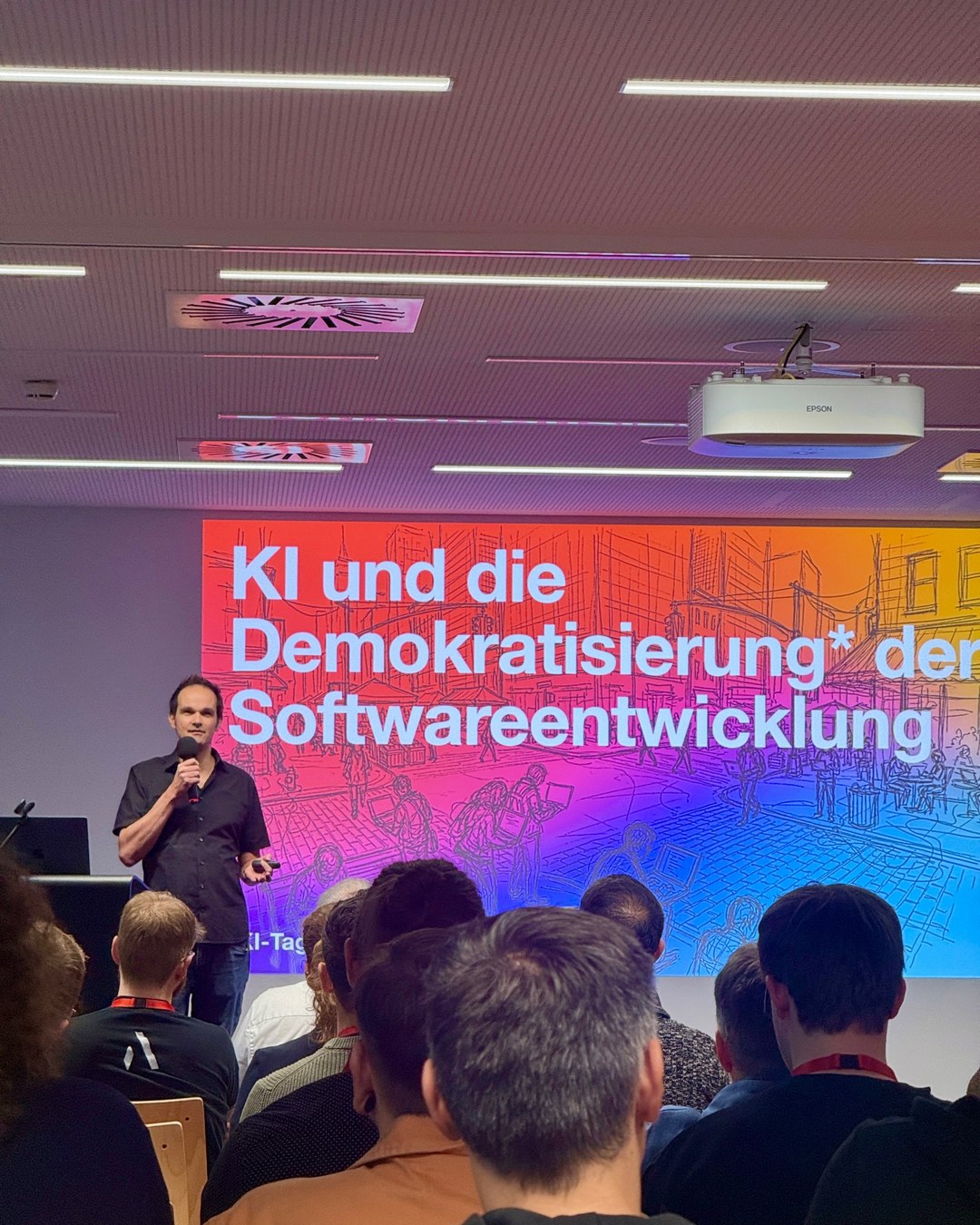
The keynote was given by Wolf Brüning, who has worked at OTTO for 15 years and heads UX design there. He spoke about the democratization of software development and was the self-declared optimist of the day. Stefan Groschupf joined via video from San Francisco. A Halle native, he founded Datameer and now runs Centrum AI. Mayor Dr. Alexander Vogt spoke for the city. Jacqueline Köppen and Yannick Büchle came from Hypoport hub SE, Dr. Stefan Hennig from ACP, and Eric Tessenow from Kieback & Peter. Johannes Kanthak and Andreas Kerndt reported on their client projects.
We took away the most from Hypoport and from Johannes Kanthak.
Hypoport: 2,200 employees and every training session fully booked
Jacqueline Köppen and Yannick Büchle have been responsible for introducing AI at Hypoport for two and a half years. It started in May 2024. At the time, employees were using ChatGPT at work, which was not compatible with data protection requirements, so IT set up its own system, HypGPT. There are now licenses for ChatGPT Enterprise, Claude and Microsoft Copilot. The training sessions were fully booked every time.
Even so, AI is used less in the company than expected. Köppen and Büchle named two reasons. Those who have been trained return to a team where the others have not. And managers working 60-hour weeks have no time to deal with it, especially in the areas where AI would make the biggest difference. The AI champions in the subsidiaries didn't change much either. They were supposed to "do something with AI" and bring everyone along, on top of their actual jobs.
That's why Hypoport is now starting with senior management. They choose one of four levels: supporting tasks, redesigning processes, handing standard cases over to AI, or redesigning the business. Before that, management had spent two months working weekly on an AI target vision that in the end consisted mostly of text. Managers fill out a canvas with eight fields for their area and present it to the group every two to four weeks. One of the fields asks about the impact on results. The two accept "I don't know" as an answer there.
The program is called SPARK. Alongside it, the company is running an "AI November" with 25 short talks by colleagues, all remote.
We appreciated that two people stood up after two and a half years and said what hadn't worked. That rarely happens at conferences.
Johannes Kanthak and the four types of work
Kanthak sorts work into knowledge, judgment, relationships and manual work. For him, knowledge covers everything that is done repeatedly according to known rules, such as quotes, research or receipt entry. In the future, AI agents will handle this, and there will be no more money to be made from it. What remains is knowledge that can't be found anywhere on the internet. Judgment gains value because someone has to take responsibility for the decision, and manual work on changing job sites isn't going anywhere anyway.
He brought two examples. A trade business has a drone survey the customer's house. Meanwhile, the tradesperson talks to the customer and types in their wishes. Along with the PDF, the customer receives a website with a 3D model of the existing building and the plans, with every component clickable and priced.
The second example was an architecture firm that needs two to five weeks for a concept. The firm anonymized the data from past projects and put it into a database, from which an AI agent generates the first sketches. The firm sells access to this database to other architecture firms via license; technically, this runs through an MCP server.
On retail, Kanthak said that the standard segment is shrinking and only premium and economy are growing. He cited Galeria and its repeated insolvencies. Against online retail and against AI agents shopping on behalf of customers, an assortment without a unique selling point stands no chance. In our view, that assessment holds true, and it is likely to affect many online shops.
In passing, he mentioned what he works with himself: Codex and Claude Code, with four licenses at 200 euros each.
The bike shop and the shipping confirmation
Andreas Kerndt demonstrated a voice assistant using made-up data from a bike shop. A customer calls and asks where their package is. They give their order number and postal code and learn that the helmet is on its way and the rear light will follow in three business days. The tracking link is sent by text message. Very important: an assistant like this must identify itself as a machine on the phone, a point Kerndt specifically emphasized.
He calls his approach AOA, which stands for analyze, optimize, automate. Before every project, he has people track for ten working days what they spend their time on. For optimization, he gave an example from online retail. If the shipping confirmation is worded more clearly, hardly anyone calls about their package anymore, and the voice assistant is no longer needed for that question.
An example from Dr. Stefan Hennig of ACP pointed in the same direction. A logistics company wanted to have AI handle scheduling for furniture deliveries and discovered that the phone calls cost it hardly anything. What was expensive was the goods sitting in the warehouse without a delivery date. In the end, the solution was to call in the evening, when recipients are at home.
Kerndt also told the story of an employee at a client company who didn't think much of AI. The man then built a small administration app for his club and has been promoting AI within the company ever since.
Who actually checked this?
Eric Tessenow is responsible for information security at Kieback & Peter. He asked the audience for a show of hands twice. First, he wanted to know who had most recently created a binding document such as a contract or a policy with AI, and many hands went up. For the second question, who had checked the document afterwards, there were significantly fewer.
Tessenow treats an AI like a new employee who is onboarded and only gradually given access to documents. Two of his experiences stuck with us. At one point, his AI mistook unpublished drafts for established practice in the company; since then, he has strictly separated the current state from anything that is merely being tested. And an AI that checks its own output, unsurprisingly, finds little. That's why, in his setup, review is kept separate from creation.
And the city of Halle?
Mayor Dr. Alexander Vogt stuck to what has to come first in public administration. Electronic files with document management are to be introduced starting in 2027. He sees a role for AI in automatically sorting incoming requests and forms and forwarding them to the right department. He was quite clear that digitalization is considered a voluntary service for municipalities and is therefore not funded.
Our recommendation to our clients:
We took a lot away from the talks. Among other things, we would pass on these two simple practical tips to our clients:
For ten working days, keep track of which questions reach your customer service. Delivery status and returns are probably near the top. Some of these can likely be resolved with a clearer shipping confirmation, no AI required.
Also clarify who in your company checks what an AI has written. This applies to quotes just as much as to product descriptions.
Comments
No comments yet.
Write a comment